




Gut Health Is the Missing Piece in Your Skincare Routine
September 14, 2026
September 14, 2026


You cleanse. You moisturize. You wear your SPF.
Maybe you've even mastered the occasional face mask without getting it in your hair.
But, what if part of your skincare routine has nothing to do with what you're putting on your skin?
We've talked a lot about gut health when it comes to digestion, because yes, your gut plays an important role in breaking down food, absorbing nutrients, and keeping things moving. But the influence of your gut doesn't necessarily stop there.
Your gut is connected to systems throughout your body, including your immune system, metabolism, and even your skin.
So if you're thinking about skin health only from the outside in, there may be another piece worth paying attention to, and that’s your gut.
Your digestive system and your skin may seem pretty far removed from each other, but researchers have been increasingly interested in the relationship between the two, often referred to as the gut-skin axis.
Your gut is home to trillions of microorganisms that make up your gut microbiome. Maintaining a diverse, balanced gut microbiome helps support digestion, nutrient absorption, immune function, and the integrity of the intestinal barrier.
And those functions can have effects that extend beyond your digestive system.
Researchers are continuing to study how changes within the gut microbiome may influence things like systemic inflammation, immune responses, oxidative stress, and skin barrier function, all of which can play a role in overall skin health.
In other words, your skin may be on the outside, but supporting it isn't necessarily an outside-only job.
That salad packed with colorful vegetables? The salmon you ordered for its healthy fats? Your morning smoothie?
Eating nutrient-rich foods is an important first step, but your body still has to digest and absorb those nutrients before it can put them to work.
Digestion breaks food down into smaller components your body can absorb and use. Nutrients such as protein, essential fatty acids, zinc, collagen, and vitamins A, C, and E all contribute to normal skin structure and function in different ways.
That's another reason supporting healthy digestion matters.
It's not only about how you feel after eating. It's also about helping your body make use of the nutrients you're giving it.
We've said it before, and we'll probably say it again:
Your gut is home to an entire ecosystem.
The bacteria and other microorganisms living there interact with one another, and with you, every single day.
A healthy gut microbiome helps support the intestinal barrier and normal immune function. When that ecosystem is supported, you're not just thinking about digestion. You're supporting one of the body's major interfaces with the outside world.
And interestingly enough, your skin has a microbiome of its own.
Researchers are still uncovering exactly how these two microbial communities communicate, but the growing understanding of the gut-skin axis is another reminder that wellness is rarely isolated to one part of the body.
Alongside the products on your bathroom counter, there are a few everyday habits that can help support skin health from within.
Fruits, vegetables, whole grains, nuts, seeds, and legumes provide fiber and plant compounds that can help support a diverse gut microbiome.
Think less about finding one "perfect" gut-health food and more about variety over time.
Fiber does more than help keep you regular.
Certain types of fiber act as prebiotics, providing fuel for beneficial bacteria in the gut. If your diet tends to fall short, gradually increasing fiber through food, or adding supplemental fiber to your routine can help you work toward your daily needs.
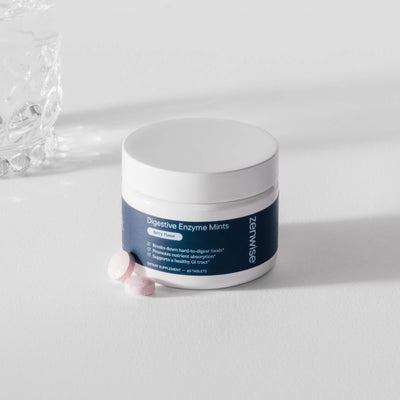
Even the most nutrient-packed meal still needs to be broken down before your body can absorb and use what’s on your plate.
That’s where digestive enzymes come in.
Your body naturally produces enzymes that help break down carbohydrates, proteins, fats, lactose, and other components of food, but as we age, production of some digestive enzymes may begin to decline.
Why does that matter for your skin? Healthy digestion helps your body break food down into nutrients it can absorb and use, including nutrients that help support healthy skin from within.
So, while you may be choosing foods for their skin-loving benefits, digestion is an important part of helping your body actually put those nutrients to work.
Your microbiome responds to the habits you repeat.
Eating a varied diet, getting enough fiber, staying active, prioritizing sleep, and incorporating fermented or probiotic-containing foods can all be part of supporting a healthy gut environment.
It's not about doing everything perfectly.
It's about giving the trillions of microorganisms living in your gut a little TLC, too.
A good skincare routine can absolutely include the cleanser, serum, moisturizer, and SPF you love.
But healthy skin is also supported by what happens inside your body.
Nutrition. Hydration. Sleep. Stress. Digestion. Your microbiome.
They're all pieces of a much bigger picture.
For a long time, we've thought about gut health primarily in terms of digestion.
Less bloating. Better regularity. Feeling more comfortable after meals.
And while digestion is certainly part of the conversation, we're learning more and more about just how connected the gut is to whole-body wellness.
Your gut communicates with your immune system. It helps your body access nutrients from food. It houses trillions of microorganisms. And through what's known as the gut-skin axis, researchers are continuing to uncover its relationship with skin health.
So keep the skincare routine, but maybe make a little room for your gut in it, too.
Because feeling your best really does start from within.*
If you have questions, we're always here to help.
Reach us anytime at support@zenwise.com or (800) 940-1972, Monday–Friday, 9 a.m.–5 p.m.
*These statements have not been evaluated by the Food and Drug Administration. These products are not intended to diagnose, treat, cure, or prevent any disease.
Share this article





