




Why Do Probiotics Bloat Me? Tips to Tame the Gas
May 11, 2026
May 11, 2026

You decided to take control of your gut health. You bought a high-quality supplement, cleared a spot on your kitchen counter, and took your first dose with high hopes for a flatter stomach and better regularity. Then, the irony hit. Instead of feeling light and comfortable, your midsection feels like an overinflated balloon. Your favorite jeans are suddenly a struggle to button, and your stomach is making noises that could rival a small construction site.
It is a frustrating paradox that many people face at Zenwise Health. You take a product to reduce bloating, only to end up feeling more bloated than before. This "initial puff" is one of the most common reasons people give up on their gut health journey before the real benefits even begin.
We believe that your path to wellness should be paved with confidence, not discomfort. Our philosophy is simple: Zenwise. Then Eat.® We want you to enjoy your food and your life without the constant worry of how your stomach will react. This guide will explain exactly why that initial bloating happens, how to tell if your probiotic is working, and how Digestive Enzymes can help you find the right balance for your unique microbiome.
Quick Answer: Probiotics may cause temporary bloating because they shift the balance of your gut microbiome, leading to a "die-off" of less helpful bacteria and increased gas production from fermentation. This is usually a sign of adjustment and typically subsides within one to two weeks as your internal ecosystem stabilizes.
It feels like a betrayal when a health supplement causes the very symptom you are trying to fix. You are not alone in this experience, and it does not necessarily mean the product is "bad" or that your body is rejecting it. In fact, for many people, a bit of initial gas is a sign that the beneficial bacteria are actually doing their job.
Think of your gut as a crowded city. When you introduce a high volume of new, beneficial bacteria, they have to find a place to settle down. This involves "evicting" some of the resident bacteria that may have been contributing to sluggish digestion or poor nutrient absorption. This microbial moving day can be a bit chaotic. As the balance of power shifts, your digestive system may react with temporary gas, gurgling, and that signature bloated feeling.
Your microbiome — the community of trillions of tiny organisms living in your gut — is a delicate ecosystem. When you start a probiotic, you are essentially dropping a new population into a space where every "apartment" is already occupied.
To make room for themselves, these new beneficial bacteria compete with the existing microbes for space and nutrients. As the less-than-helpful bacteria are crowded out, they can release metabolic byproducts. This process can lead to temporary inflammation or a shift in how gas moves through your intestines.
Not all bacteria are created equal when it comes to this transition. Some traditional strains are very delicate and may die off in the harsh environment of the stomach. When this happens, you aren't getting the full benefit, but you might still get the digestive "noise."
We focus on using hardy strains like those in our Digestive Enzymes formula. This is a spore-forming probiotic, which means it has a natural protective shell. Think of it like a tiny microbial space suit that allows the bacteria to survive the journey through your stomach acid. Because it reaches the small and large intestines intact, it can begin working more efficiently. While this effectiveness is great for long-term health, the sudden arrival of these "pro-level" microbes can trigger an adjustment period.
The primary job of many beneficial bacteria is to help break down the food your body couldn't handle on its own. This process is called fermentation. While fermentation is a healthy and necessary part of digestion, it has one major byproduct: gas.
When you introduce new strains of bacteria, they may be exceptionally good at fermenting certain fibers or sugars in your diet. Digestive Enzymes work alongside these bacteria to simplify your food. If the bacteria find a surplus of undigested food to feast on, they produce hydrogen or methane gas.
Key Takeaway: If you feel bloated after taking a probiotic, it often means the bacteria are actively fermenting food in your colon. This is a sign of activity, but it can be uncomfortable if your system isn't used to that level of microbial work.
Many people don't realize that their probiotic supplement often contains a hidden partner: prebiotics. Prebiotics are specific types of fiber that act as fuel for the good bacteria. While they are essential for helping your probiotic thrive, they are also highly fermentable.
If your gut is not used to high levels of fiber, the sudden addition of prebiotics can cause significant gas and bloating. Common prebiotics like Inulin or FOS (Fructooligosaccharides) are known for being "dramatic" in the digestive tract.
At Zenwise, we aim for a balanced approach. Our Digestive Enzymes formula includes a 3-in-1 combination of enzymes, prebiotics, and probiotics. By including the enzymes first, we help break down the food before it reaches the bacteria, which may help reduce the amount of "fuel" available for excessive gas production.
There is a phenomenon often referred to as a "die-off" reaction. As the beneficial probiotics begin to outnumber the harmful microbes, those less helpful bacteria die. When they do, they can release substances that temporarily irritate the gut lining.
This can result in:
The Proof Is In The Poop™ is a phrase we use because your bathroom habits are the best indicator of your internal health. During the first week of a new probiotic, you might notice your "output" looks a bit different. This is part of the rebalancing process. For most people, this transition is a sign that the "good guys" are winning the battle for your gut.
One reason you might feel bloated without seeing any real benefits is that your probiotic isn't surviving your stomach. If the bacteria die in your stomach acid, they become just another piece of organic material for your body to process, rather than a living tool for your health.
If you are taking a "live culture" probiotic that isn't shelf-stable or enteric-coated (designed to dissolve in the intestines), you might be experiencing "dead-load" bloating. Your body is trying to process the bulk of the supplement without receiving the active microbial support it needs. This is why we prioritize spore-forming strains and high-quality delivery systems in our Zenwise Health products.
You don't have to just "grin and bear it" while your gut adjusts — NO BLØAT® is designed for those moments. There are several practical steps you can take to minimize the discomfort and help your microbiome transition smoothly.
Step 1: Start low and go slow. If you are very sensitive, you don't have to take a full dose on day one. You can start by taking your supplement every other day for the first week. This gives your existing microbiome time to adjust to the new neighbors without a total "hostile takeover" feeling.
Step 2: Time it right. Taking a probiotic on an empty stomach vs. with food can change how you feel. For many, taking it with a meal provides a "buffer" that can slow down the fermentation process and reduce the immediate gas spike.
Step 3: Hydrate, hydrate, hydrate. Water is the primary mover of the digestive system. It helps flush out the byproducts of bacterial die-off and keeps fiber moving through the intestines. If you increase your probiotic or prebiotic intake without increasing your water, you are essentially creating a digestive traffic jam.
Step 4: Check your "fillers." Read the "Other Ingredients" list on your supplement bottle. Some brands use fillers like lactose, maltodextrin, or artificial sweeteners that can cause bloating in sensitive individuals. We keep our formulas focused on what your gut actually needs.
bottom line: Most probiotic-induced bloating is temporary. If you can stay consistent for 10 to 14 days, the "puff" usually disappears, leaving you with a more efficient and comfortable digestive system.
Sometimes, the reason probiotics cause bloating is that the rest of your digestion is struggling. If you have a shortage of natural enzymes, large particles of undigested food reach your colon. When the probiotics meet this undigested food, they go into a fermentation frenzy.
This is why we often recommend a comprehensive approach. Instead of just adding bacteria, you may need to support the entire process of breaking down food with Digestive Enzymes.
Enzymes are the biological "scissors" that cut your food into absorbable pieces.
By taking a supplement like our Digestive Enzymes, you are helping the body do the "heavy lifting" of digestion. When food is properly broken down in the stomach and small intestine, there is less leftover "junk" for the bacteria in the large intestine to turn into gas.
We believe that gut health shouldn't be a chore or a source of anxiety. We have designed our products to address the specific moments where digestion usually goes off the rails.
If you are currently in the middle of a "probiotic puff" or you just finished a heavy meal that you know will cause trouble, NO BLØAT® is designed for you. It is specifically formulated to provide relief within hours, not weeks. It uses a combination of:
For long-term consistency, our 3-in-1 Digestive Enzymes are the daily core of a healthy routine. They combine the power of enzymes with the prebiotic/probiotic support of DE111®. This formula helps ensure that your food is broken down properly before the probiotics go to work, which can significantly reduce the "adjustment bloat" many people fear.
For women, gut health is often tied to vaginal and urinary tract health. Our Tribiotic Complex delivers prebiotics, probiotics, and postbiotics to support gut health, vaginal balance, and optimal pH. Because women's digestive systems can be particularly sensitive to hormonal shifts, a targeted probiotic can help maintain balance across multiple systems.
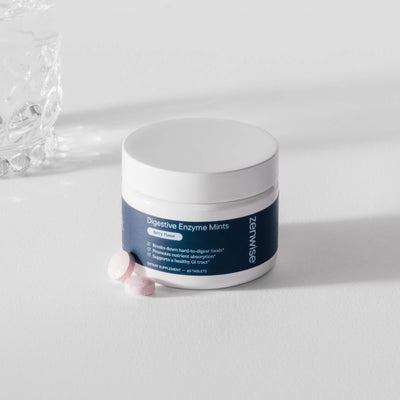
If you want something effortless and tasty after a meal, our Digestive Enzyme Mints are a great way to kickstart digestion. They are perfect for those "on-the-go" moments when you feel a little bit of post-meal heaviness and want to encourage your system to keep moving.
It is easy to blame the new supplement, but sometimes the timing is just a coincidence. Before you toss your bottle in the trash, consider these other common "bloat-makers" that might be working against you:
| Bloat Trigger | Why it Happens |
|---|---|
| Eating Too Fast | You swallow excess air, which gets trapped in the digestive tract. |
| Carbonated Drinks | The bubbles in your soda or sparkling water end up as gas in your gut. |
| Straw Usage | Sucking through a straw is a common way to swallow extra "hidden" air. |
| High FODMAP Foods | Certain healthy foods (like garlic, onions, and beans) are naturally high in fermentable sugars. |
| Stress | Your gut and brain are connected; stress can slow down digestion, leading to stagnation and gas. |
Myth: "If I'm bloating, the probiotic is making me sick." Fact: For the vast majority of people, bloating is a sign of a microbial shift. It is a functional change, not a sign of illness. Your body is simply relearning how to process gas and balance its new inhabitants.
The key to good health is gut health, and the key to gut health is consistency. Your microbiome does not change overnight. It is a living, breathing part of you that responds to regular, sustained support.
When you use our Digestive Enzymes Subscribe & Save option, you aren't just saving 15% — you are committing to a habit. The gut thrives on routine. Jumping from brand to brand or taking a probiotic only when you feel "off" doesn't give the beneficial bacteria enough time to establish themselves.
Think of it like going to the gym. The first week is usually painful. Your muscles are sore, and you might wonder why you're doing it. But by week three or four, you feel stronger, and the initial discomfort is a distant memory. Your gut is exactly the same. Give it the time it needs to transform.
While temporary bloating is normal, you should always be your own best advocate. If you experience severe pain, persistent diarrhea, or bloating that doesn't go away after two full weeks of consistent use, it may be time to reassess.
Everyone's microbiome is as unique as a fingerprint. What works for your best friend might not be the perfect fit for you. If a specific formula feels too "aggressive," you can try a different delivery method, such as a chewable, or focus more on the enzyme side of the equation until your gut feels more stable.
Sometimes the "moving day" effect takes a few days to peak. As the new bacteria begin to multiply and colonize, they may reach a "critical mass" where their fermentation activity becomes more noticeable. This usually indicates that the bacteria have successfully survived the stomach and are now active in the intestines.
Yes, and for many people, this is actually the preferred method. Digestive Enzymes help break down the "fuel" (food) so that the probiotics can focus on balancing the microbiome rather than struggling to ferment large, undigested food particles. This combination can lead to a much smoother transition with less gas.
The best signs of progress are increased regularity, less post-meal heaviness, and a more consistent "output" (The Proof Is In The Poop™). You may also notice that after the initial week or two of bloating, your stomach feels flatter and more comfortable than it did before you started the supplement.
In most cases, we recommend sticking with it for at least 14 days. If the gas is very uncomfortable, try reducing your dose by half or taking the supplement with your largest meal of the day. This slow-and-steady approach usually allows the gas to subside without losing the long-term benefits of the probiotic.
These statements have not been evaluated by the Food and Drug Administration. This product is not intended to diagnose, treat, cure or prevent any disease.
The journey to a healthier gut isn't always a straight line. If you are asking "why do probiotics bloat me," remember that you are likely just in the middle of a very normal biological adjustment. Your gut is a complex system that is constantly striving for balance.
Key Takeaway: Don't let a temporary "puff" stop you from achieving food freedom. Support your system with enzymes, stay hydrated, and give your microbiome the gift of time.
By choosing high-quality, science-backed solutions like those at Zenwise Health, you are giving your body the tools it needs to thrive. We want to help you move past the "dramatic stomach" phase and into a life where you can simply eat, enjoy, and feel your best.
To ensure your gut has the consistent support it needs to maintain this new balance, consider our Digestive Enzymes Subscribe & Save program. You’ll receive 15% off every order, and more importantly, you’ll never miss a day of the routine that keeps your microbiome in check. Consistency is the secret to long-term gut health—let us help you make it easy.
These statements have not been evaluated by the Food and Drug Administration. This product is not intended to diagnose, treat, cure or prevent any disease.
Share this article


