




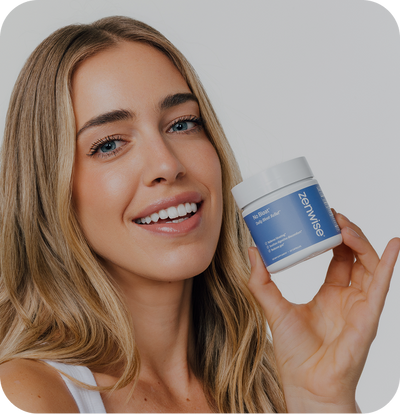
What Is Better: Digestive Enzymes or Probiotics?
February 04, 2026
February 04, 2026

We’ve all been there: you’re at a beautiful dinner, the pasta looks divine, and the conversation is flowing. But halfway through the meal, you feel it—that familiar, uncomfortable tightening of your waistband. Suddenly, you aren’t thinking about the dessert menu; you’re thinking about how quickly you can get home to change into sweatpants. This "menu anxiety" and post-meal regret are signs that your digestive system might need a little extra support. When searching for relief, you’ll likely encounter two heavy hitters in the wellness aisle: digestive enzymes and probiotics.
But when it comes down to it, what is better: digestive enzymes or probiotics? The truth is, they aren't competitors; they are more like the ultimate tag-team for your torso. One handles the immediate "work" of breaking down your lunch, while the other manages the long-term "environment" of your gut. At Zenwise Health (Zenwise®), we believe that understanding these differences is the first step toward food freedom. Our goal is to help you navigate these choices so you can live by our favorite motto: "Zenwise. Then Eat.®" Because at the end of the day, we know that "The Key To Good Health Is Gut Health.®"
In this comprehensive guide, we are going to dive deep into the mechanics of how your body processes food, the specific roles of enzymes versus probiotics, and how to choose the right support for your unique lifestyle. Whether you’re dealing with occasional gas, bloating, or just want to ensure you’re getting the most nutrients out of your kale salad, we’ve got you covered.
To understand whether you need an enzyme, you first have to understand what they actually do. Imagine your digestive system is a high-end recycling center. Food enters the facility as large, complex "pallets" of proteins, fats, and carbohydrates. Your body can’t use these pallets as they are; it needs them broken down into individual bricks.
Digestive enzymes are the "scissors" or "saws" of the operation. They are non-living proteins that act as catalysts, accelerating chemical reactions that break down these large polymers into smaller, absorbable units.
Your body naturally produces enzymes in several places:
For many people, the body’s natural production of these enzymes can be affected by age, stress, or even just a particularly "adventurous" meal. This is where a supplement like our Digestive Enzymes becomes a game-changer. Our formula features BioCore Optimum Complete, a comprehensive blend of enzymes designed to tackle everything from the fiber in beans to the fats in a ribeye steak.
The beauty of enzymes is their speed. Because they are active proteins that work directly on the food currently sitting in your stomach, they provide immediate support. If you take them right before you eat, they get to work instantly, helping to ensure that food doesn't sit undigested in your gut, which is often the primary cause of that heavy, "brick in the stomach" feeling.
While enzymes are the tools that break down food, probiotics are the living "staff" that manage the facility. Probiotics are live, beneficial microorganisms (mostly bacteria and some yeasts) that reside primarily in your large intestine (the colon).
Unlike enzymes, probiotics don't "eat" your dinner for you. Instead, they focus on the ecosystem. They help maintain a balanced environment, crowd out less desirable bacteria, and support the integrity of your gut lining. They are the long-term residents responsible for the "The Proof Is In The Poop™"—that feeling of regularity and ease that defines a healthy gut.
One of the biggest challenges with probiotic supplements is survivability. Many standard probiotic strains are fragile and die off in the harsh, acidic environment of the stomach before they ever reach the colon.
In our Digestive Enzymes, we include DE111®, a clinically studied spore-forming probiotic (Bacillus subtilis). Think of the "spore" as a protective suit of armor. This allows the probiotic to survive the trek through your stomach acid and arrive in your gut alive and ready to work. It supports immune health and helps maintain a healthy gut flora, which is essential for long-term digestive comfort.
Sometimes, the gut ecosystem needs a specialized touch. For women, the microbiome isn't just about the gut; it’s also about vaginal and urinary tract health. Our Women’s Probiotics are formulated with specific strains like L. acidophilus and L. plantarum, combined with Cranberry and D-Mannose. This "multi-tasking" approach ensures that while you’re supporting your digestion, you’re also maintaining the delicate pH balance required for overall female wellness.
If you’re still asking "what is better: digestive enzymes or probiotics," the answer depends entirely on your current symptoms and your goals. Let's look at the comparison side-by-side.
| Feature | Digestive Enzymes | Probiotics |
|---|---|---|
| What are they? | Non-living proteins (catalysts) | Living microorganisms (bacteria/yeast) |
| Primary Goal | Break down food into nutrients | Balance the gut microbiome |
| Speed of Action | Immediate (works during the meal) | Cumulative (works over days/weeks) |
| Best For... | Gas, bloating, and heaviness after eating | Regularity, immune support, and long-term balance |
| Where they work | Mostly the stomach and small intestine | Mostly the large intestine (colon) |
You should reach for Digestive Enzymes if your primary issues occur shortly after eating. If you find that certain foods—like a big plate of broccoli, a bowl of chili, or a glass of milk—leave you feeling like a parade float within an hour, enzymes are your best friend. They help bridge the gap between what you want to eat and what your body is currently equipped to handle.
Probiotics are the better choice if you are looking for systemic support. If you struggle with irregularity, have recently finished a course of antibiotics, or feel like your immune system needs a boost, a daily probiotic is the way to go. It’s about building a foundation for health that lasts, rather than just managing a single meal.
At Zenwise Health, we know that gut health isn't lived in a lab—it’s lived at the pizza parlor, on airplanes, and at holiday dinners. Here is how to apply this knowledge to your actual life.
Scenario: You’re headed out for a celebratory Italian dinner. You know the combination of heavy carbs, garlic, and perhaps a little dairy in the sauce usually results in "bloat-face" and a stomach that feels three sizes too big by 9 PM.
Solution: This is a job for No Bloat Capsules. While our daily enzymes are great for maintenance, NO BLØAT® is our lifestyle hero for crisis management. It contains the BioCore Optimum Complete enzyme blend to break down the meal, but it also includes Dandelion Root (to help with water retention), Fennel, and Ginger. These botanicals work to ease gas and flatten the appearance of your stomach within hours. It’s the ultimate "insurance policy" for your favorite meals.
Scenario: You don't necessarily have a "crisis" every day, but you often feel "meh" after lunch. You’re trying to eat more fiber and protein, but your gut seems to be complaining about the change in diet.
Solution: You need a comprehensive, "3-in-1" daily support system. Our Digestive Enzymes provide exactly that. By combining prebiotics, probiotics (DE111®), and a full spectrum of enzymes, you are covering all your bases. The prebiotics feed the good bacteria, the probiotics balance the ecosystem, and the enzymes make sure your lunch doesn't become a lingering problem.
Scenario: You’ve finished a great meal and had a small dessert, but now you feel a little bit of acidity or mild discomfort. You don't want to swallow a capsule; you just want a little something to kickstart the process.
Solution: Reach for our Papaya Chewables. These are tasty, effortless, and perfect for post-meal support. They use the natural power of papain (from papaya) and bromelain (from pineapple) to kickstart protein digestion and soothe the stomach. They are the perfect "digestive mint" to keep in your purse or car.
The question "what is better: digestive enzymes or probiotics" often misses a crucial point: they actually work better together.
When you take digestive enzymes, you are ensuring that food is thoroughly broken down. When food isn't broken down properly in the small intestine, it travels into the large intestine in large chunks. There, your gut bacteria begin to ferment those chunks, which creates gas and discomfort. By using enzymes to do the "heavy lifting" upstairs, you make the job much easier for your probiotics downstairs.
By taking both, you create a seamless flow of digestion. The enzymes handle the breakdown, and the probiotics handle the cleanup and maintenance. This is why our flagship Digestive Enzymes are so popular—they don't make you choose. They give you the benefits of both in one simple capsule.
We know that the supplement world can be a bit of a "wild west." That’s why we focus on clinical science and transparency. When we talk about our products, we aren't making "miracle" claims. We are talking about biology.
Our formulas are designed to be accessible. We aren't here to lecture you on your diet or tell you to stop eating the foods you love. We want to give you the tools to enjoy those foods with confidence. Whether you are using No Bloat Capsules for a specific event or keeping a bottle of Papaya Chewables on your nightstand, you are taking a step toward better gut health.
Let’s be honest: talking about gas, bloating, and "the poop" can be awkward. But at Zenwise Health, we think it’s time to stop whispering. Digestive issues are a universal human experience. By using a little humor and a lot of science, we hope to destigmatize these topics. Because once you stop being embarrassed by your gut, you can start taking care of it.
The gut microbiome is a living, breathing community. Like a garden, it doesn't stay healthy if you only water it once a month. To see the real, transformative benefits of probiotics and enzymes, consistency is absolutely critical.
This is where many people fall off the wagon. They take a supplement for three days, feel a little better, and then forget about it until the next time they eat a block of cheese. To help you stay on track, we’ve made it as easy (and affordable) as possible.
We highly recommend our Subscribe & Save model for anyone serious about their gut health. When you subscribe, you automatically get 15% off every order. More importantly, it ensures that you never run out. Having your Digestive Enzymes or Women’s Probiotics show up at your door right when you need them removes the friction of having to remember to reorder.
Consistency allows the DE111® probiotic to properly colonize and the enzyme levels in your system to remain optimal. It’s a small investment in your daily comfort that pays huge dividends in how you feel, how your clothes fit, and how much you enjoy your meals.
So, what is better: digestive enzymes or probiotics? As we’ve discovered, they are two sides of the same coin. Enzymes are your "right now" solution for breaking down food and preventing that post-meal bloat, while probiotics are your "always" solution for a balanced, happy gut ecosystem.
If you are just starting your journey, think about your most pressing symptom. Is it the immediate discomfort after dinner? Start with No Bloat Capsules or our core Digestive Enzymes. Are you looking for long-term regularity and immune support? Make a daily probiotic your new best friend.
At Zenwise Health, we are here to partner with you on this journey. We believe that when your gut is healthy, the rest of your life follows suit. You have more energy, more confidence, and most importantly, the freedom to eat the foods you love without fear.
Ready to take the next step? Don't wait for the next "jeans-too-tight" moment. Join the Zenwise Health family today. Subscribe & Save now to get 15% off your order and ensure that your gut health routine is as consistent as your appetite. Remember: Zenwise. Then Eat.®
Yes! In fact, taking them together is often the most effective strategy for complete digestive support. Enzymes help break down food in the stomach and small intestine, while probiotics support the microbiome in the large intestine. Our flagship Digestive Enzymes actually combine both into one convenient capsule to provide a "3-in-1" solution.
Digestive enzymes typically work during the meal you take them with, providing support within hours. Probiotics, however, are living organisms that need time to colonize your gut. While some people feel a difference in a few days, it generally takes 2 to 4 weeks of consistent, daily use to see the full benefits of a probiotic supplement.
There is no clinical evidence to suggest that supplemental digestive enzymes cause your body to stop its natural production. Supplements simply provide additional "tools" to help your body process food more efficiently, especially when you are eating large meals, complex fibers, or foods you are sensitive to.
For the best results, digestive enzymes should be taken about 15–20 minutes before a meal, or with your first bite. This ensures the enzymes are present as the food enters your system. Probiotics can be taken at any time, but many people find it easiest to take them with breakfast to establish a consistent daily routine.
These statements have not been evaluated by the Food and Drug Administration. This product is not intended to diagnose, treat, cure or prevent any disease.



